


Businesses constantly look for ways to improve productivity, reduce costs, deliver better quality, and create a more consistent customer experience. Yet many improvement initiatives fail because organisations try to solve problems without understanding their actual causes.
Lean Six Sigma provides a structured approach to solving this challenge. It combines Lean thinking, which focuses on removing waste and improving flow, with Six Sigma, which focuses on reducing variation, defects, and process instability.
The result is a practical improvement methodology that can be applied across manufacturing, healthcare, logistics, banking, IT, construction, oil and gas, and many other industries.
What Is Lean Six Sigma?
Lean Six Sigma is a data-driven approach to process improvement.
Lean focuses on identifying activities that consume resources without creating meaningful value for the customer. Examples include unnecessary movement, waiting time, excessive inventory, repeated approvals, overproduction, and unnecessary processing.
Six Sigma focuses on reducing variation and defects by understanding how a process behaves and identifying the factors that influence its performance.
Together, the two approaches help professionals ask better questions:
- What exactly is the problem?
- How is the current process performing?
- What is causing the problem?
- Which improvements will have the greatest impact?
- How can the improvement be sustained?
This is what makes Lean Six Sigma different from simply implementing a new idea and hoping that performance improves.
Understanding the DMAIC Approach
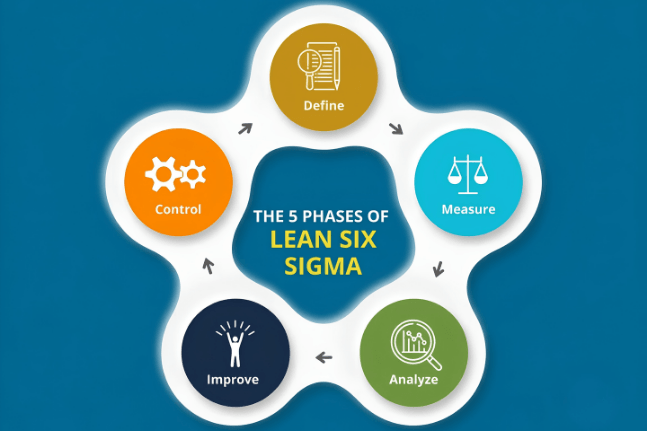
One of the most widely used structures in Six Sigma improvement is DMAIC:
Define: Clearly identify the problem, business impact, project scope, and customer requirements.
Measure: Establish reliable baseline data and understand how the current process performs.
Analyze: Investigate the data and identify the potential root causes of the problem.
Improve: Develop, test, and implement solutions that address the verified causes.
Control: Put appropriate controls and monitoring mechanisms in place so that the improvement is sustained.
The important point is that DMAIC does not encourage teams to jump directly from a problem to a solution. It creates a logical path from understanding the problem to verifying its causes and then implementing an appropriate improvement.
Why Root Cause Analysis Matters
Consider a manufacturing company experiencing a high rejection rate.
A team may initially conclude that operators need more training. Training might be useful, but it could also be the wrong solution.
Further investigation may reveal that the actual issue is inconsistent raw material quality, an unstable machine setting, unclear work instructions, or variation between production shifts.
Without structured analysis, the organisation could spend time and money treating a symptom instead of addressing the real cause.
Tools such as Pareto analysis, cause-and-effect diagrams, process mapping, measurement analysis, and statistical techniques can help teams move from assumptions to evidence.
Lean Six Sigma Is Not Only for Manufacturing
One common misconception is that Lean Six Sigma is mainly a manufacturing methodology.
In reality, many service organisations have complex processes with significant opportunities for improvement.
A bank may use process improvement to reduce loan-processing turnaround time.
A hospital may analyse patient-flow processes to reduce waiting.
A logistics company may investigate delivery delays and inventory issues.
An IT service organisation may improve ticket resolution times and SLA performance.
An oil and gas organisation may focus on reliability, maintenance processes, operational efficiency, and risk reduction.
The process may look different in every industry, but the underlying improvement principles remain highly relevant.
What Does a Green Belt Professional Do?
A Lean Six Sigma Green Belt professional typically works on process improvement projects while applying structured problem-solving techniques.
Green Belt skills can help professionals:
- Define improvement opportunities
- Map and understand processes
- Collect and interpret process data
- Identify root causes
- Use appropriate improvement tools
- Reduce defects and variation
- Improve process performance
- Monitor and sustain improvements
- Communicate project results to stakeholders
The value is not simply in knowing the names of improvement tools. The real value comes from knowing when and how to use them.
Why Data Matters
A process problem can often look obvious at first.
For example, a manager may believe that delays are caused by employee workload. Once the data is examined, however, the largest delays may occur because requests are waiting for approval.
This distinction matters.
Data helps improvement teams separate perception from evidence. It also makes it easier to prioritise opportunities and demonstrate whether a change actually produced an improvement.
A successful improvement project therefore needs more than enthusiasm. It needs a clearly defined problem, reliable measurements, appropriate analysis, and a method for confirming results.
Building a Continuous Improvement Culture
Lean Six Sigma becomes more valuable when it is not treated as a one-time project methodology.
Organisations can use the same mindset to create a culture where employees continuously look for opportunities to improve processes.
Instead of asking only, “Who made the mistake?” teams begin asking:
“What in the process allowed this problem to occur?”
That shift can encourage more constructive problem solving. It moves attention away from blame and toward process understanding.
How Professionals Can Apply These Skills
You do not need to be a dedicated quality professional to benefit from Lean Six Sigma.
The methodology can be particularly useful for professionals working in:
- Quality and process excellence
- Operations
- Manufacturing
- Engineering
- Supply chain and logistics
- Healthcare
- Banking and financial services
- IT and shared services
- Business transformation
- Project management
If your role involves improving a process, reducing problems, managing performance, or delivering measurable results, Lean Six Sigma skills can provide a practical framework for doing that work more systematically.
Final Thoughts
Lean Six Sigma is ultimately about making better decisions based on a better understanding of how processes actually work.
The methodology provides structure, but the real impact comes from applying that structure to meaningful business problems.
For professionals, developing Lean Six Sigma skills can strengthen analytical thinking, problem-solving ability, and process improvement capability. For organisations, these skills can support more consistent processes, better quality, reduced waste, and measurable operational improvement.
The strongest improvement professionals are not those who simply know the most tools. They are the ones who know how to select the right approach, understand the problem, work with data, involve stakeholders, and turn analysis into sustainable results.